De Bellis Antiquitatis is a fast-play rule set that grew out of a streamlining of the old WRG rules of yore. It aims to put players in charge of ancient armies with a birds’ eye view of the battlefield.
There is little book-keeping, with no tokens, no morale checks and very simple command and control. The 1d6 PIP command roll and the combat resolution of opposed d6 plus combat factors give the core of the rules.
The basic mechanics have spawned countless imitators — or should I say homages? — in the historicals area. It promotes fast play and generally feels reasonable, although geometric movement shenanigans still exist.
I wrote last time about my belief that getting historical results with fewer rules is the core of elegance; today I want to dive into the mathematics of the combat resolution in DBA and how it makes things smoooooth.
The system
Combat is extremely simple to resolve: each player rolls a d6 and adds factors for their troop type and a range of modifiers such as support or being uphill, and subtracts for being overlapped or fighting in adverse terrain. The lower value generally recoils, or is destroyed if their score is doubled. There are a variety of exceptions for various interactions but we will skip that for the moment.
Let’s take a look at the probabilities:
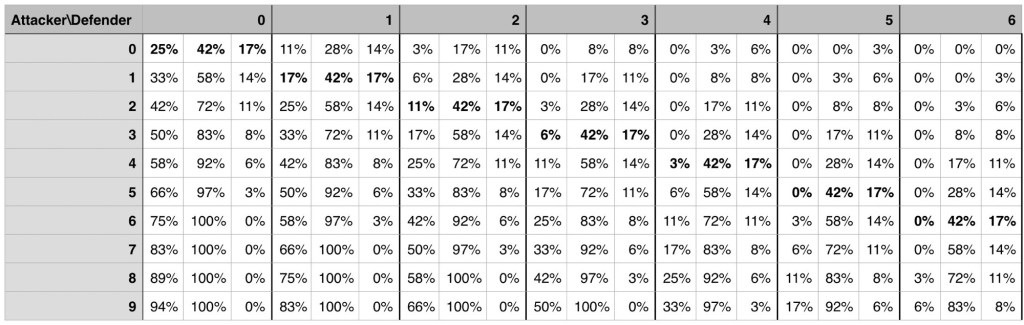
To read the graph, find your total combat factor on the left and then scan across to your opponent’s. You will find three percentages in each group, which are the probabilities to:
- win by doubling your opponent;
- win (including doubling and just exceeding); and
- have an equal result.
I agonised for some time about separating winning by doubling from winning but not doubling; I decided to assume that the average DBA player can subtract two numbers if they really want that specific probability.
While theoretically a +10 is possible (a Blade General defending a fort), around 5 or 6 is a practical upper limit in most games, in my humble experience.
The upshot
Looking at the numbers, we notice a few things (we of course use the royal ‘we’ but please play along with the affectation).
Draws are most common when factors are equal. Not the most exciting result but relevant for solid foot fans (by that I mean people who enjoy infantry elements that move 2BW, not stocky people with a fascination for toes). Solid foot are more likely to recoil the opponent which can create more overlaps; consider this when determining your ordering. This also matters when considering some of the weird edge cases like knights against blades or longbows where a draw is as good as doubling.
Lower factors are swingier. Combats between lower factors have much higher probabilities for doubling your opponent, but also for being doubled. That is to say, that at lower factors (say +2 and below) the results are extremely dicey. The classic wing battle of light horse or psiloi squaring off against their equals can go either way and can easily be a rout. This feels historical, though; many battles were determined by a sudden cavalry breakthrough that left a flank completely exposed and ripe for an attack (not that we are singling anyone out, Rupert). In comparison, well-trained fighters are likely to push-and-shove until overlaps result in a sudden collapse in the line.
Inflicting negatives is higher risk, higher reward than gaining a positive factor. In a vacuum, setting up an additional overlap on an enemy helps your chances of killing more than countering one of their overlaps on you. In both cases, you are improving your factor by one compared to theirs; however, reducing theirs makes it easier to double them. Now, it isn’t always strictly better, as it also leads to your factor being lower and being easier to double. As discussed above, lower combat factors are more prone to extremes. Determining if it is worth the risk is left as an exercise for the reader. Ask yourself if you are a bold Scipio or a conservative Fabius.
It doesn’t do half-measures. To some of you this is a downside as there is no gradual loss of efficacy. Those of you who hate having a batch of tokens for panic, shaken, stirred, routed, tired, slightly distracted, peckish, and mildly perturbed on the field will appreciate it. In this case, the loss of efficacy is reflected in a formation rather than a single unit, as gaps open, overlaps start to occur and there are never enough PIPs to rectify your own damnably poor luck while punishing the enemy’s obvious errors (certainly never the other way around). The design logic being that the general was unaware of each unit’s casualties and morale until they broke; the game does the same to minimise book-keeping and maintain high-level verisimilitude.
It is easy to roll a d6. The combat is simple to resolve: roll a die and add a number, check to see if there are any other modifiers. No dice pools, no hit/wound/save, no wound tracking. Active player gets to pick the order, resolve one at a time and apply it immediately. Generally, the results feel historical, although it does go to some length to get particular results: Cannae and Agincourt are taken as vital data points, hence the somewhat arbitrary combat results such as “Longbows kill Knights on a tie” and “blades pursue foot (except psiloi)”.
The so what
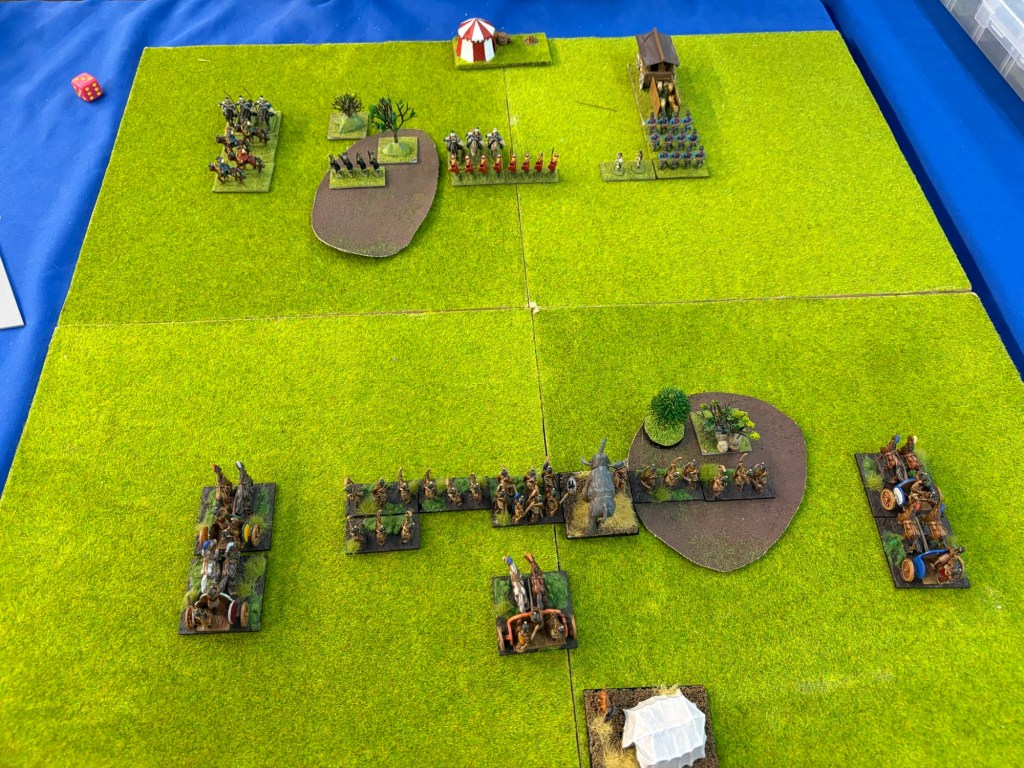
DBA is fast, fast, fast. Command is extremely simple to resolve but gives crunchy decisions, and combat is similar. This fairly simple combat mechanic has been used in plenty of other systems and is generally quite acceptable to history simulationists. It sticks to the simple premise of low amounts of information (no tokens, no casualty tracking within elements) and a high-level view of the battle. For all of its quirks, it is a system that gives the player the tough decisions of ancient warfare and the option to play boldly and try to win quickly, or to play conservatively and hope to win through an accrual of optimal decisions. Or maybe just throw some dice and have fun, and don’t overthink it.


Leave a Reply