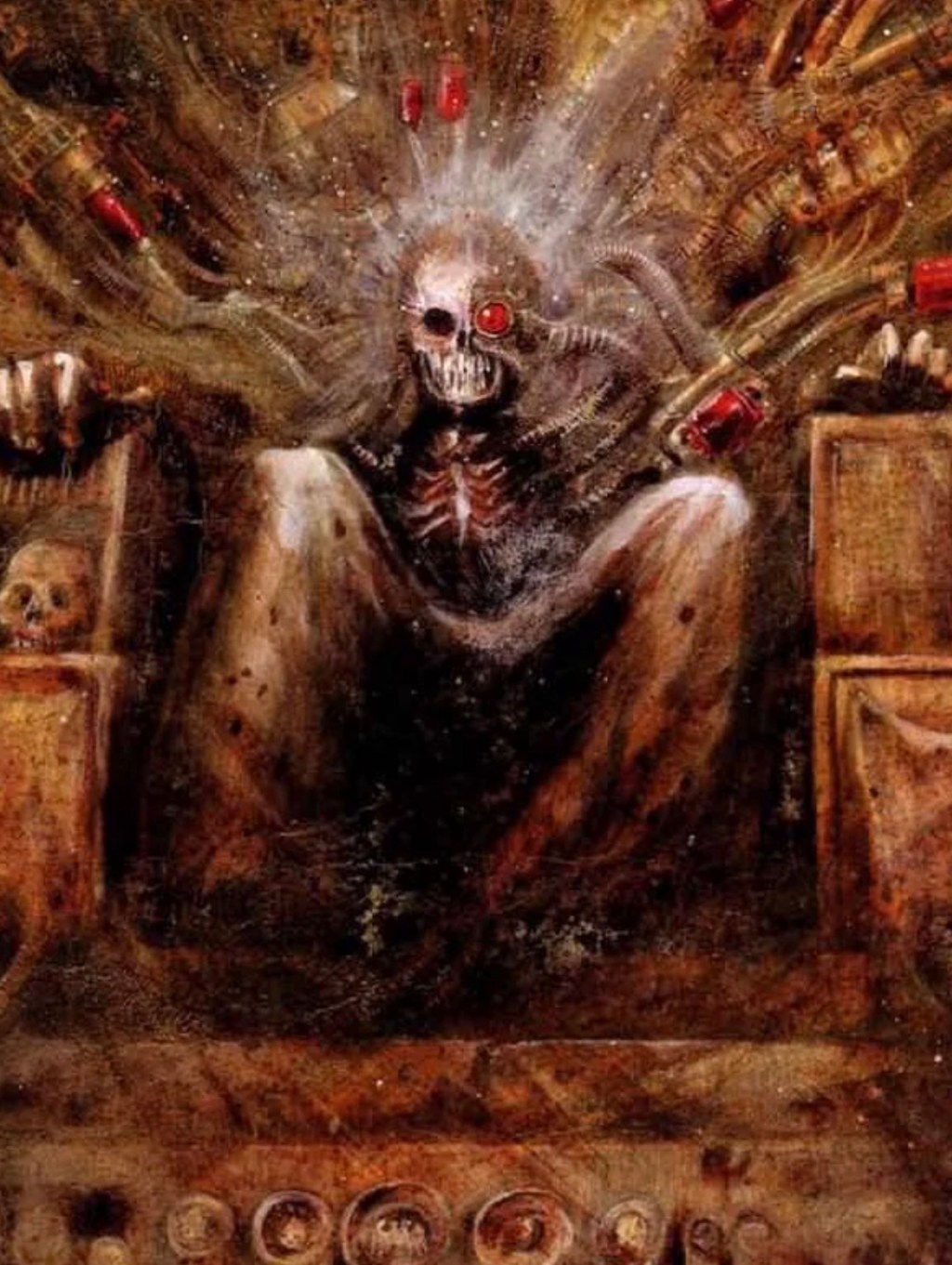
With (another!) new edition of the biggest, grimmest, darkest, far-futurest, science-fictional wargame stomping into reality, I felt it time to blather on about my journey with 40k and where it has come from.
A simpler time…
Picture an era of Warhammer fantasy 4th edition and Warhammer 40,000 2nd edition. A bright-eyed young whipper snapper picks up a White Dwarf and is immediately hooked on the ‘Eavy Metal miniatures (which were actually both ‘eavy and metal at the time) and the impressive battle reports. It was certainly a different time and I suspect one that many wargamers remember fondly with rose-coloured glasses, or perhaps don’t remember at all.
The WHFB box contained what felt like thousands of mono-pose goblins and high elves, and the 40k box was replete with Space Marines, Orks and grots, and more cardboard tokens and templates than was healthy. White Dwarf regularly contained cardboard punch-out scenery, mini board games, advice for scratch building terrain and vehicles, and articles about building an army over several months on a reasonable monthly budget. The game felt lower stakes, more zany, more customisable, and less serious; the article about a grav-tank made from a deodorant stick lives in the subsidised housing of my brain.
It was a plastic and cardboard paradise for young gamers.
The grim darkness
With 40k second edition, the game had grown from its role-playing background into a wargame. Players would bring about 1500-2000 points of miniatures, which would give them a couple of beefy characters, around 2 to 5 squads and a vehicle or two for an afternoon’s play. This would constitute a combat patrol of about 500 points and maybe an additional unit these days.
The rules were much more detailed, and gave individual miniatures more character. Wargear was far more wild, weapons were lethal but less accurate, vehicles could explode chaotically at the drop of a hat, and close combat was a bitter but decisive struggle. Let’s take a look at how elements of 40k have changed from 2nd ed to today.
The aesthetics and setting
Let’s start big picture. In the mid 90s, the background was still being developed. The Horus Heresy was hinted and alluded to as an explanation for a galactic civil war, but we knew very little about these mythical primarchs beyond their names. Everything was left as a half-explained premise for players to build upon. Online discussion on lists and forums would often involve people writing their own fluff (not lore) for their army, and turning their tabletop exploits into a detailed backstory. Many are the heroic tales that are still etched into my memory, like the heroic Land Speeder gunner who (in 3rd edition) single-handedly took out my Eldar Dreadnought in one round of shooting (a roughly 1 in 20,000 occurrence).
The ‘Eavy Metal paint-style of the day used bold colours and strong contrasts, mainly because the paints of the day needed a white undercoat to have any chance of creating a smooth coat. Highlights were added by mixing in white or bone, and the washes were actual artists’ ink. It leant itself to a strikingly bright look, borrowing from the punk and metal aesthetics of the late 80s and early 90s. GW used to be counter-culture and had strong ties to the metal scene. I remember that GW stores (when I had travelled the 800km to the nearest one) always had punk or metal playing, and the people were proud to not be normies.
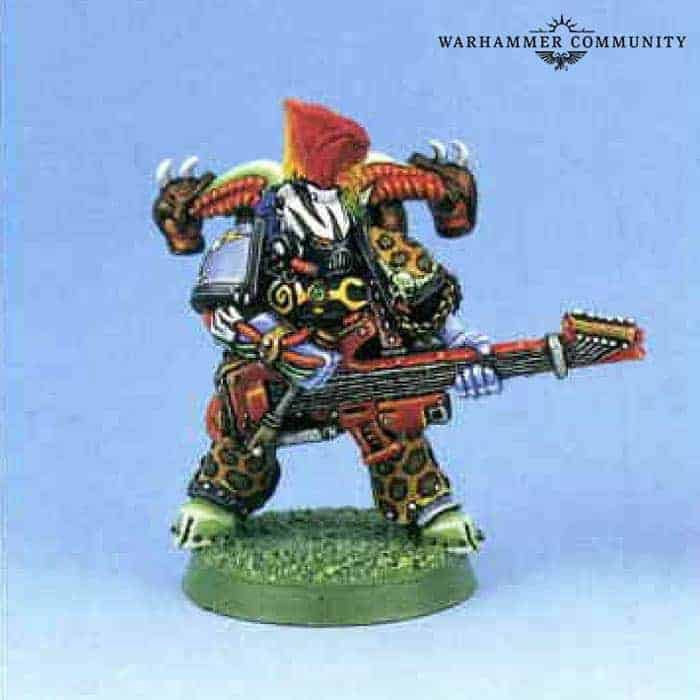
Garish banners could be cut from magazines and affixed to minis, rather than being integrally sculpted as they are today. Compare this to the darker, grittier, more ‘realistic’ styles of today, with the emphasis on edge highlights until the cows come home.
Overall, it felt more edgy; not in a trying-to-be-offensive-for-no-reason way, but it was cheeky, self-aware, unexplored, and more malleable to the players’ desires of the setting. Today, everything has been written about a dozen times, and almost nothing is left unexplored or ambiguous. Special Characters are fully fleshed out and extremely common, rather than “only if your opponent agrees to this unique character showing up in a tiny gunfight”.
The rules
The second edition of 40k was a halfway house between a role-playing game and a wargame. If you wanted to represent an entire company of marines against an ork Waaaagh, then you had Space Marine/Epic 40k. Second edition 40k was for a small strike force trying to take down a strong point, or a forward advance trying to break through an enemy scouting party. These games were small, objective driven, and far more granular.
The actual rules were fairly straight-forward—other than hand-to-hand fighting—and the complexity came from resolving vehicle damage, and some items of wargear.
As an example: vehicle damage in 2nd ed was completely different to the wounds-based damage of now. When a vehicle was hit, you made a penetration roll, based on the weapon’s strength, damage and other modifiers against the relevant facing. If you beat armour you then rolled for the location of the hit, leading to another table of possible effects. Each vehicle had unique hit locations and damage tables, contained on a Datafax that came in the relevant codex. For instance, shooting a jetbike could destroy it in one hit, disable a weapon, or send it spinning out of control and crashing into a squad of infantry.
The Eldar (not the far more copyright-able Aeldari) Distortion cannon could bend space-time, so a hit target might be shredded instantly, or perhaps teleport underground and create a cataclysmic explosion from quantum chaos. Or maybe we should just make it strength one trillion and do devastating wounds on a 6, yeah that’s way more fun and interesting.
Some of the effects were a bit too much, such as resolving a squad throwing grenades as a shooting attack, or virus outbreaks; either of these could take a loooong time to resolve and be a real slog for little benefit.
In 3rd edition onwards, the game was deliberately slanted towards more stuff, faster resolution and even less of the table-top RPG feel. Points values were roughly halved (tactical marines going from 33 to 15 points), while the recommended game size remained at 1500 points. Suddenly, players had way more stuff on the board so of course the complexity had to give if games were to have any chance of finishing before another edition is printed.
Thus, weapons profiles were drastically simplified, wargear was dulled right down, dice-roll modifiers to hit or for armour save were removed, close combat attacks were resolved similarly to shooting, non-d6 dice disappeared, and all vehicles used a generic damage chart.
Third edition brought its own issues, with guns being less mobile and less lethal, and transports became a guaranteed delivery system for Blood Angels and Space Wolves on turn one. Fourth and fifth editions cleaned up the worst of third’s shenanigans and gave us some brilliant customisation for Marines and Guard, so you could really make your dudes. The Index Astartes articles fleshed out the fluff and gave a prototype for how to write a background for your favourite made-up chapters, as well as providing a little niche for each of the original 20 18 legions with subtle army restrictions and bonuses.
Nowadays, Knight banners and Primarchs are common on the table top. Apparently every expeditionary force is led by a 10,000-year-old super warrior who would rather stand within 3” of an arbitrary point for 5 turns than solve galaxy-spanning existential threats.
While I am ok with the game shifting towards larger confrontations and thus having more place for super-heavy tanks and knights, the rules should streamline further and further; I am completely lost when I try to learn the various stratagems, formations and other rules that all stack. This is all on top of the rapidly shifting “meta” that determines the best armies in the echo chamber.
The elephant in the chat room
People have always complained about the churn of new rules, new models and the new hotness that must be beaten.
The difference is that 25 years ago, the “meta” was knowing who played what at your club. If you knew the cheesy Space Wolf player was coming, you might bring some extra lascannons to take out the transports.
Tournaments were an excuse for a booze-up with painting scores attached. Much time online was devoted to discussing the right balance between the scores for sporting behaviour, painting and generalship. The fact remained that winning the game was only part of the experience; a tournament winner generally had to have a nice army and not be a complete bellend.
Today, every release is instantly analysed by the online echo chamber so the optimum lists may be determined. Tournaments are many players’ reason to play, rather than an event which punctuates a club’s year.
It’s a shame to me, because 40k was always a beer-and-pretzels, blow-some-stuff-up way to pass a day with some mates. It wasn’t balanced and that was ok because it was narrative and generated cool storylines. Now it’s a beardy, win-at-all-costs competition, at least if you listen to the online dialogues. New players coming to the game looking for information are swamped by clickbait rage-farmers on YouTube and hyperbolic Reddit posts; they miss out on the community of nerds who want to paint some dudes and roll some dice to generate stories about their favourite little guardsman-that-could.
Don’t get me wrong; I love tournaments and a well-balanced competitive game. There is a place for competitive players in this broad church. I just want competition and razor-thin margins of balance to be situated as one aspect of a huge hobby, where the voices of the casual and the grognards are heard equally.
Or maybe I should just keep fantasising about an era of my life that was long ago, and go play Xenos Rampant instead.


Leave a Reply